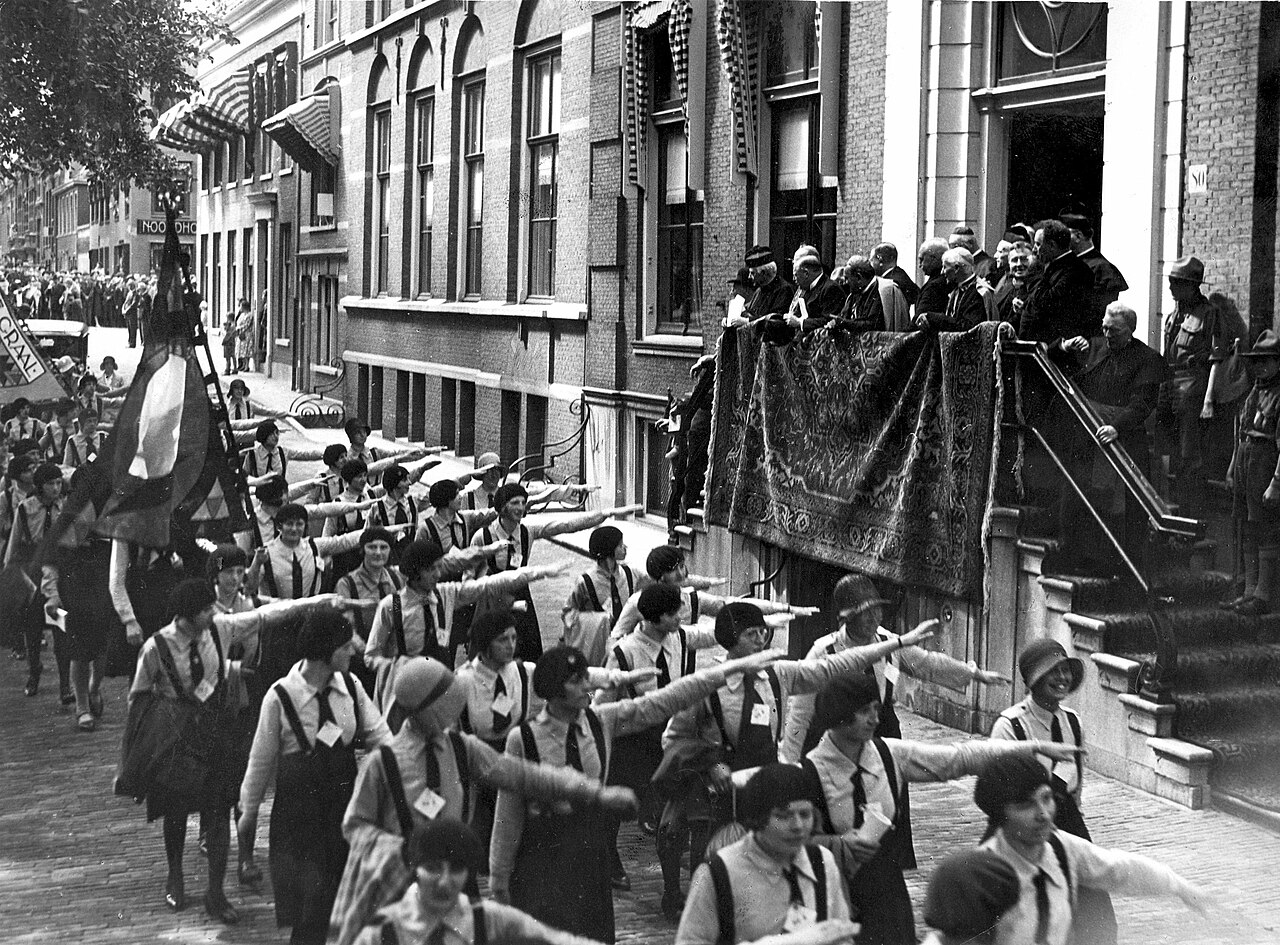
Well, it's a point of view!Point set match: Scary, deathly costumes (ghosts, skeletons, the grim reaper) and "souling" (proto-trickortreating) is a very old medieval Catholic Halloween custom; Conversely, dressing your kids as saints is a virtue-signaling, faggy, ahistoric humiliation ritual fabricated a decade ago by evangelical-adjacent parish-councilwomen w/ less piety than imagination
— Timothy Gordon (Rules for Retrogrades Show) (@timotheeology) October 30, 2026
Friday, October 30, 2026

Tuesday, September 15, 2026
Ὑπὸ τὴν σὴν εὐσπλαγχνίαν, καταφεύγομεν, Θεοτόκε. Τὰς ἡμῶν ἱκεσίας, μὴ παρίδῃς ἐν περιστάσει, ἀλλ᾽ ἐκ κινδύνων λύτρωσαι ἡμᾶς, μόνη Ἁγνή, μόνη εὐλογημένη.
DEUS, cui omne cor patet, et omnis voluntas loquitur, et quem nullum latet secretum, purifica per infusionem Sancti Spiritus cogitationes cordis nostri: ut te perfecte diligere, et digne laudare mereamur.
O King to whom all birds are dear, speed now this feathered shaft, and recall some pity for the Noldor in their need!
Tuesday, September 8, 2026
Virgo haud verisimilis?

Is it significant that Our Lady's star sign is Virgo ♍?
I suppose there was only an 8.33% chance of it.
(Is that small enough to be significant?)
Monday, August 24, 2026
Dickie Attenborough, RIP
Mark Steyn had a lovely little obit for the late Labour life peer Lord Attenborough, and left his best 'til last.
In the Nineties, Attenborough returned to acting, to supporting roles (Jurassic Park) and occasional leads (the remake of Miracle On 34th Street), but one of his late directorial assignments is a very low-key, small-scale but tremendously assured film. In 1994, he released Shadowlands, "based on a true story" of C S Lewis' relationship with an ex-Commie Jewish-American divorcee. As with Gandhi and Chaplin, the "true story" was rather more complex, but Attenborough managed to penetrate deeper into the real shadowlands than his big biopics do, and he drew two splendid performances from his leads. "You're the truest person I've ever known," Anthony Hopkins (as Lewis) tells Debra Winger, and you believe it because you see it for yourself; she's one of those actresses whose straightforward honesty - the rueful, lopsided smiles, dark curls tousling the head - dignifies even the silliest movie. But she's even better here, dying of bone cancer without turning it into disease-of-the-year Oscar-bait.
For a love story, there's not much kissing or touching, at least for the first hour, but Attenborough manages to breathe life into the usual English movie portrait of repressed dysfunctional ninnies. Hopkins and Winger maintain a stiff formality: he doesn't know what to do; she does, but she finds pleasure in waiting for him. In the distance between them, the passion is palpable. You long for him to take her hand, to kiss her, and the longer you wait, the more intense is the sheer romance. During the Encaenia at Oxford, in the middle of the national anthem, Hopkins stares across the massed ranks of college dignitaries and finds Miss Winger, unfamiliar with the words of but nodding teasingly along. In effect, Attenborough turns "God Save The Queen" into the meet-cute love song. Later, at the garden party, she playfully reaches up and brushes something from his face. Later still, when she comes home from hospital to find he's pushed together two single beds, she asks him to describe his bedtime routine. These may well be the three funniest scenes a somewhat humorless director ever shot, and they're very affecting.I've never actually seen the original version of Shadowlands, which is possibly just as well. And it's terribly disappointing that the film-version utterly fails to capture Lewis's character, or his thought, or even the feel of the Narnia books. But Oxford is beautiful, Oxfordshire is beautiful, England is beautiful, Wales is beautiful, Anthony Hopkins's voice is beautiful, every performance Edward Hardwicke ever gave was a thing of beauty, and at the time Joseph Mazzello was at his most beautiful (and he's still fairly dishy to this day!) - and basically the moral of the film, as far as I can make out, is that in the 1950s everything was beautiful, and that's why we still need films like Shadowlands - to remind us, so that we can remember.
Sunday, July 12, 2026

Sunday, July 5, 2026

Tuesday, June 16, 2026
A Tale from the Decameron
 |
| John William Waterhouse, A Tale from the Decameron (1916) |
I know this is long, and you can see why Boccaccio used to be on the Index, but I think it's great.
In Paris, gracious ladies, as I have heard tell, there was once a great merchant, a large dealer in drapery, a good man, most loyal and righteous, his name Jehannot de Chevigny, between whom and a Jew, Abraham by name, also a merchant, and a man of great wealth, as also most loyal and righteous, there subsisted a very pclose friendship. Now Jehannot, observing Abraham's loyalty and rectitude, began to be sorely vexed in spirit that the soul of one so worthy and wise and good should perish for want of faith. Wherefore he began in a friendly manner to plead with him, that he should leave the errors of the Jewish faith and turn to the Christian verity, which, being sound and holy, he might see daily prospering and gaining ground, whereas, on the contrary, his own religion was dwindling and was almost come to nothing. The Jew replied that he believed that there was no faith sound and holy except the Jewish faith, in which he was born, and in which he meant to live and die; nor would anything ever turn him therefrom. Nothing daunted, however, Jehannot some days afterwards began again to ply Abraham with similar arguments, explaining to him in such crude fashion as merchants use the reasons why our faith is better than the Jewish. And though the Jew was a great master in the Jewish law, yet, whether it was by reason of his friendship for Jehannot, or that the Holy Spirit dictated the words that the simple merchant used, at any rate the Jew began to be much interested in Jehannot's arguments, though still too staunch in his faith to suffer himself to be converted. But Jehannot was no less assiduous in plying him with argument than he was obstinate in adhering to his law, insomuch that at length the Jew, overcome by such incessant appeals, said:—"Well, well, Jehannot, thou wouldst have me become a Christian, and I am disposed to do so, provided I first go to Rome and there see him whom thou callest God's vicar on earth, and observe what manner of life he leads and his brother cardinals with him; and if such it be that thereby, in conjunction with thy words, I may understand that thy faith is better than mine, as thou hast sought to shew me, I will do as I have said: otherwise, I will remain as I am a Jew." When Jehannot heard this, he was greatly distressed, saying to himself:—"I thought to have converted him; but now I see that the pains which I took for so excellent a purpose are all in vain; for, if he goes to the court of Rome and sees the iniquitous and foul life which the clergy lead there, so far from turning Christian, had he been converted already, he would without doubt relapse into Judaism." Then turning to Abraham he said:- -"Nay, but, my friend, why wouldst thou be at all this labour and great expense of travelling from here to Rome? to say nothing of the risks both by sea and by land which a rich man like thee must needs run. Thinkest thou not, to find here one that can give thee baptism? And as for any doubts that thou mayst have touching the faith to which I point thee, where wilt thou find greater masters and sages therein than here, to resolve thee of any question thou mayst put to them? Wherefore in my opinion this journey of thine is superfluous. Think that the prelates there are such as thou mayst have seen here, nay, as much better as they are nearer to the Chief Pastor. And so, by my advice thou wilt spare thy pains until some time of indulgence, when I, perhaps, may be able to bear thee company." The Jew replied:—"Jehannot, I doubt not that so it is as thou sayst; but once and for all I tell thee that I am minded to go there, and will never otherwise do that which thou wouldst have me and hast so earnestly besought me to do." "Go then," said Jehannot, seeing that his mind was made up, "and good luck go with thee;" and so he gave up the contest because nothing would be lost, though he felt sure that he would never become a Christian after seeing the court of Rome. The Jew took horse, and posted with all possible speed to Rome; where on his arrival he was honourably received by his fellow Jews. He said nothing to any one of the purpose for which he had come; but began circumspectly to acquaint himself with the ways of the Pope and the cardinals and the other prelates and all the courtiers; and from what he saw for himself, being a man of great intelligence, or learned from others, he discovered that without distinction of rank they were all sunk in the most disgraceful lewdness, sinning not only in the way of nature but after the manner of the men of Sodom, without any restraint of remorse or shame, in such sort that, when any great favour was to be procured, the influence of the courtesans and boys was of no small moment. Moreover he found them one and all gluttonous, wine-bibbers, drunkards, and next after lewdness, most addicted to the shameless service of the belly, like brute beasts. And, as he probed the matter still further, he perceived that they were all so greedy and avaricious that human, nay Christian blood, and things sacred of what kind soever, spiritualities no less than temporalities, they bought and sold for money; which traffic was greater and employed more brokers than the drapery trade and all the other trades of Paris put together; open simony and gluttonous excess being glosed under such specious terms as "arrangement" and "moderate use of creature comforts," as if God could not penetrate the thoughts of even the most corrupt hearts, to say nothing of the signification of words, and would suffer Himself to be misled after the manner of men by the names of things. Which matters, with many others which are not to be mentioned, our modest and sober-minded Jew found by no means to his liking, so that, his curiosity being fully satisfied, he was minded to return to Paris; which accordingly he did. There, on his arrival, he was met by Jehannot; and the two made great cheer together. Jehannot expected Abraham's conversion least of all things, and allowed him some days of rest before he asked what he thought of the Holy Father and the cardinals and the other courtiers. To which the Jew forthwith replied:—"I think God owes them all an evil recompense: I tell thee, so far as I was able to carry my investigations, holiness, devotion, good works or exemplary living in any kind was nowhere to be found in any clerk; but only lewdness, avarice, gluttony, and the like, and worse, if worse may be, appeared to be held in such honour of all, that (to my thinking) the place is a centre of diabolical rather than of divine activities. To the best of my judgment, your Pastor, and by consequence all that are about him devote all their zeal and ingenuity and subtlety to devise how best and most speedily they may bring the Christian religion to nought and banish it from the world. And because I see that what they so zealously endeavour does not come to pass, but that on the contrary your religion continually grows, and shines more and more clear, therein I seem to discern a very evident token that it, rather than any other, as being more true and holy than any other, has the Holy Spirit for its foundation and support. For which cause, whereas I met your exhortations in a harsh and obdurate temper, and would not become a Christian, now I frankly tell you that I would on no account omit to become such. Go we then to the church, and there according to the traditional rite of your holy faith let me receive baptism." Jehannot, who had anticipated a diametrically opposite conclusion, as soon as he heard him so speak, was the best pleased man that ever was in the world. So taking Abraham with him to Notre Dame he prayed the clergy there to baptise him. When they heard that it was his own wish, they forthwith did so, and Jehannot raised him from the sacred font, and named him Jean; and afterwards he caused teachers of great eminence thoroughly to instruct him in our faith, which he readily learned, and afterwards practised in a good, a virtuous, nay, a holy life.
[Boccaccio, Decameron (Rigg trans.), Day I, Novel 2]

Sunday, June 14, 2026

Sunday, June 7, 2026
Thursday, June 4, 2026
The Eucharistic Face of Christ
It turns out that this is just a piece of JPII mumbo-jumbo.

Very odd, though!

Very odd, though!
Wednesday, June 3, 2026
Last Son of Narnia?

The line appears in the original 1978–1990 BBC series of All Creatures Great and Small, specifically in Series 6, Episode 10 ("The Best Time").
In that episode (set around the early 1950s), a young girl has renamed her dog "Lucy" after a character from a book she's reading, and Siegfried Farnon (played by Robert Hardy) reacts positively when he recognizes it. He enthusiastically calls The Lion, the Witch and the Wardrobe one of the greatest books ever written (or words to that very close effect, praising it highly in the context of the conversation).
It's a charming, brief moment that fits Siegfried's character—he's often the more cultured, literary-minded of the vets, quick to reference classics or show his educated side.
As for the fourth-wall aspect: yes, it's a delightful in-joke with real biographical resonance. Robert Hardy studied English at Magdalen College, Oxford, after World War II (his studies were interrupted by wartime RAF service), and C S Lewis was one of his tutors there. Hardy spoke fondly of Lewis in interviews over the years, describing him as an inspiring (if sometimes intimidating) figure during tutorials. The connection adds a nice layer of meta-authenticity to the scene—Hardy isn't just delivering a line as Siegfried; there's a personal warmth and genuine admiration behind it.
It's not a blatant break like a camera wink, but it does feel like a subtle nod from Hardy (and perhaps the production) to Lewis's legacy, especially since the Narnia books were still relatively fresh classics in the show's 1980s airing period (the episode first broadcast in 1989). Fans of both series often spot these kinds of overlaps—there are even minor crossover connections in casting between All Creatures and various Narnia adaptations over the decades.
Re-watching the classic series, it's one of those little details that makes the whole thing feel even more lived-in and personal.
Interestingly enough, there's even a follow-up and perhaps slightly more subtle reference to Narnia in Series 7 Episode 2. Siegfried (mis)quotes Thomas Carlyle's "Speech is human, silence is divine, yet also brutish and dead; therefore we must learn both arts." He then remarks that "Speech is human: it's what separates us from the animals." - which sounds a lot like a sentiment of Robert Hardy's old tutor again. (Funnily enough, Screwtape says something similar to Carlyle about music and silence - only of course he hates them both, preferring diabolical noise!)
Interestingly enough, there's even a follow-up and perhaps slightly more subtle reference to Narnia in Series 7 Episode 2. Siegfried (mis)quotes Thomas Carlyle's "Speech is human, silence is divine, yet also brutish and dead; therefore we must learn both arts." He then remarks that "Speech is human: it's what separates us from the animals." - which sounds a lot like a sentiment of Robert Hardy's old tutor again. (Funnily enough, Screwtape says something similar to Carlyle about music and silence - only of course he hates them both, preferring diabolical noise!)
Perhaps less interestingly, but still quite randomly, the original Siegfried on film was played by none other than Anthony Hopkins, who went on to play Lewis himself in the remake of Shadowlands. (And, for what it's worth, the director of that film, who was of course Sir Richard Attenborough, died in the same residence as Hardy would just a few years later.)
And Hardy himself would make his own indirect contribution to the "Oxford" school of fantasy" when he took on the part of Cornelius Fudge in the Harry Potter films.
Monday, June 1, 2026

Sunday, May 24, 2026
Samurai Monk Gandalf
Monday, May 11, 2026
Knots and Crosses... and Crossings
 first dropped into Treadwells about fifteen years ago. According to my records, I was actually looking for a pack of Tarot cards for my friend Madge. I think I would also have been interested in finding a copy of this book. I went there thinking a lot about symbols - of the faith, of grace, and in the non-Christian or "secular" sphere.
One symbol I saw a lot of at Treadwells was the Tree of Life. Another was of course the pentagram, which is actually more interesting than you'd think. Tolkien and Gordon have notes on it in their commentary on Gawain, where it features on the hero's shield and is referred to as the seal of Solomon (cf. Solomon's knot, which isn't really a knot; the Buddhist Endless Knot; and of course the star of David). In Gawain obviously it also symbolises virtue, and the Five Wounds of Our Lord. I have read that there is a tradition that Solomon wore this seal on his ring, like a signet-ring, and it gave him power over demons. (A Ring of Power, anyone?)
The inverted cross was of course originally the symbol of St Peter, who was crucified upside down, and hence of the Popes. My suspicion is that it is nowadays associated with the Antichrist partly because of ludicrous claims by protestants that the Pope is the Antichrist (even though, of course, there have been lots of Popes, whereas there is only ever going to be one Antichrist).
There are other old folk-tale characters who have "haunted" me over the years, so to speak. One is of course the Wild Huntsman, whom modern pagans refer to as the Horned God. (He's very popular with pagan gays.) Another, of course, is Wade, who was either a sort of secular St Christopher or indeed his "pre-Christian predecessor" - someone, perhaps, to be invoked at river-crossings just as St Christopher would have been. The chap's name means exactly what it sounds like, and he's portrayed in Denmark as doing just that, except that the little boy he carries on his shoulder is not the Christ Child but his son Wayland the Smith. We know so much and yet so little about him (from Chaucer et al.) that it's like living in five hundred years' time and only knowing about Luke Skywalker from in-jokes in The Simpsons.
Another thing! Do these people actually have anything to do with the Grail? Presumably they do - although, given that even in the Middle Ages, when the Church and the Grail romances were at the height of their influence in real terms, the romances were still not officially acknowledged by the clergy, it seems the quintessence of bad taste. (And what's with their translation of the Psalter?)
Friday, May 1, 2026
DC Comics Releases Comic Where Jesus Christ Is the Central Point of History.✝️
— sacredchad (@sacredchad_ig) May 1, 2026
After 37 years locked in the vault, DC finally released the “banned” Swamp Thing #88, making the crucifixion of Jesus an official part of DC continuity. pic.twitter.com/3j32TnUhpf
DC Comics Releases Comic Where Jesus Christ Is the Central Point of History.
After 37 years locked in the vault, DC Comics finally released the “banned” Swamp Thing #88, making the crucifixion of Jesus an official part of DC continuity.
The issue was written by Rick Veitch in 1989 and titled “Morning of the Magician.” It was scheduled to be the conclusion of a time-travel arc that sent Swamp Thing backwards through history. The final stop was first century Jerusalem, where he witnesses the Garden of Gethsemane and the events of the Gospel.
DC executives removed the issue before it hit shelves. They objected to depicting Jesus Christ in a mainstream comic. Veitch resigned in protest and refused to work for DC again.
The story sat unpublished for 37 years. Now it has officially been released, placing the crucifixion of Jesus Christ at the center of DC continuity.

May Morning
 |
| ‘May Morning on Magdalen Tower’ 1890, by Holman Hunt |
Hunt attended the May Morning ceremony and made initial observations about it in 1888. The Walker Art Gallery has a watercolour study of the details of the tower, which Hunt studied for several weeks. For the figures in the painting he chose boys from Magdalen College but also used the choir of Westminster Abbey. Not only did Hunt have problems with the choice of models but he also realised that the ceremony was not popular with people outside the Magdalen College, as he confessed in a letter to his wife after his second stay in Oxford in December 1888. The vivid and individual expressions of all the figures suggest that they were all modelled from the choir as well as members of the College. The youth of the boys reflects the fertility and blossoming of nature during May. The young boy looking directly out at us is holding a lily, the symbol for St Mary the Virgin and St Mary Magdalen to whom the College was dedicated.
Te Deum Patrem colimus,Te Laudibus prosequimus,qui corpus cibo reficis,coelesti mentem gratia.
Te adoramus, O Jesu,Te, Fili unigenite,Te, qui non dedignatus essubire claustra Virginis.
Actus in crucem, factus estirato Deo victimaper te, Salvator unicevitae spes nobis rediit.
Tibi, aeterne Spirituscuius afflatu peperitinfantem Deum Maria,aeternum benedicimus.
Triune Deus, hominumsalutis auctor optime,immensum hoc mysteriumorante lingua canimus.
[Dr Nathaniel Ingelo and Benjamin Rogers, Hymnus Eucharisticus]
Back in 2013, Auntie did the honours here.
Saturday, April 25, 2026
St Mark

The above is from the front of the Doge's Palace in Venice.
Today is of course also the Robigalia - one of those old crop fertility festivals dedicated to extra-cruel chthonic deities, to whom the Romans would sacrifice animals of the non-edible variety (normally puppies).
And I just couldn't resist this.
And I just couldn't resist this.
Friday, April 3, 2026
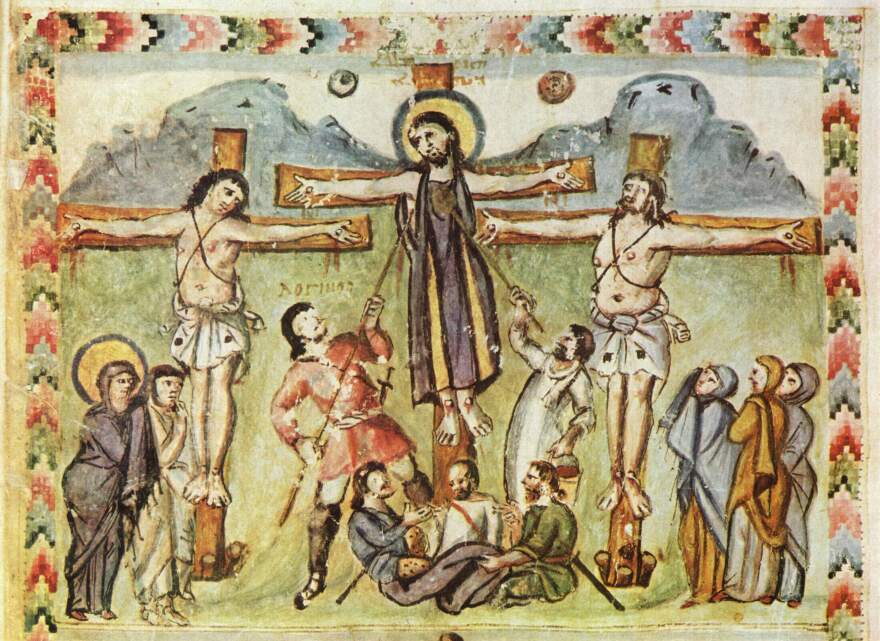
Biblical Foundation
The Gospels describe “darkness over the whole land” from the sixth to the ninth hour (noon to 3 p.m.) while Jesus hung on the cross (Matthew 27:45; Mark 15:33; Luke 23:44–45). Luke specifically notes that “the sun was darkened” (or “the sun’s light failed” / “τοῦ ἡλίου ἐκλιπόντος”). This supernatural daytime darkness—sometimes linked to apocalyptic imagery like Revelation 6:12 (sun turning black, moon blood-red)—gave artists a powerful visual hook. The presence of both sun and moon together (unnatural in reality) underscores the miracle and the universe’s response to Christ’s death.
Earliest Depictions (6th Century)
Crucifixion imagery itself was rare before the 5th–6th centuries (early Christians often avoided graphic suffering scenes). One of the oldest surviving examples with the celestial bodies is the Rabbula Gospels (Syriac manuscript, completed 586 CE, now in Florence). Here, a partly eclipsed sun and a personified moon (with a face) hover above the cross against a light sky, with shading hinting at darkness. This sets the pattern: the sun and moon signal both the literal darkness and the cosmic scale of the event.
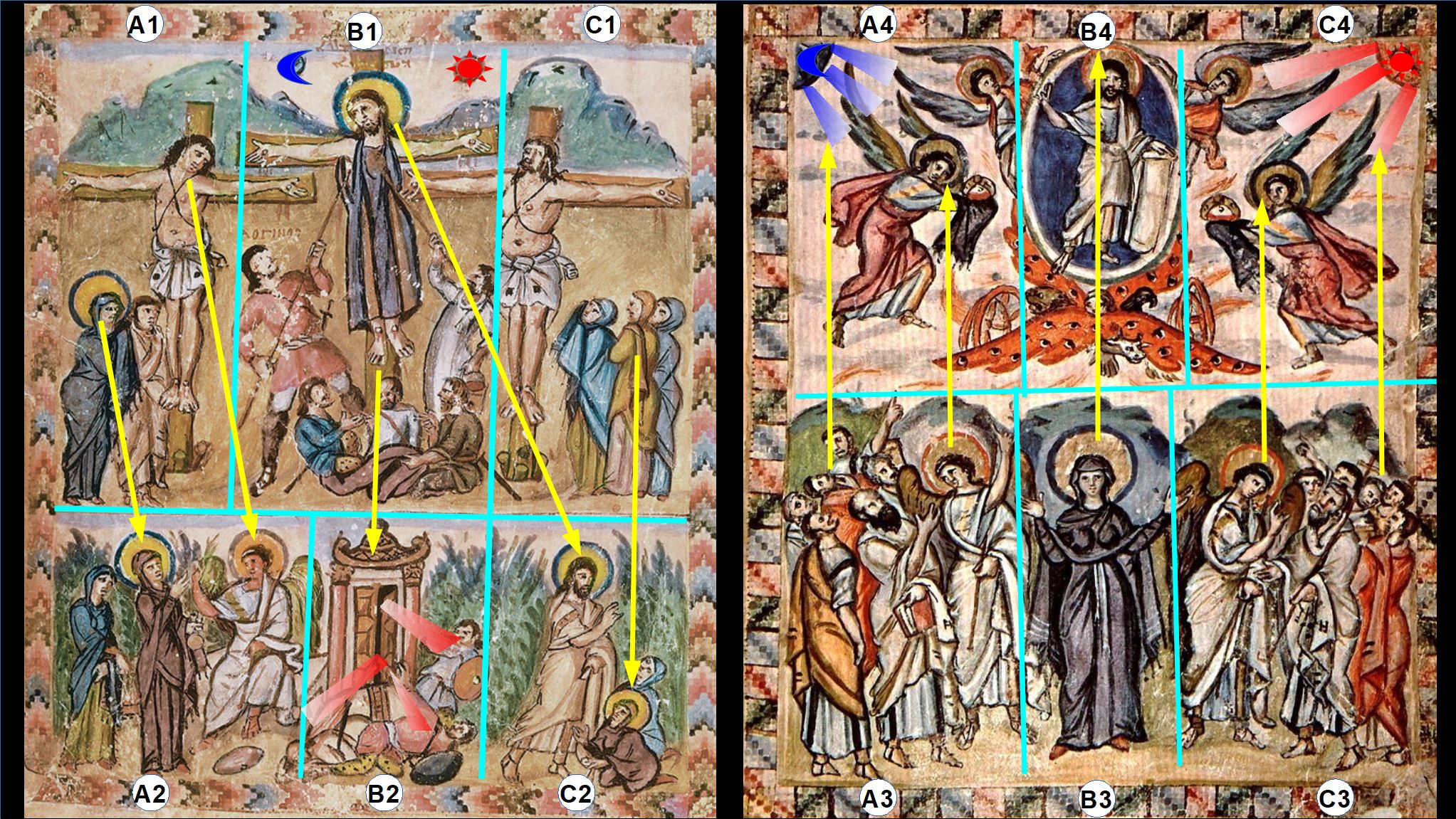
Medieval Standardization and Personification (8th–13th Centuries)
By the Carolingian period (8th–9th centuries) and onward through Romanesque and Gothic art, sun and moon became standard features in both Eastern (Byzantine/Orthodox) and Western traditions. They are typically shown as:
- Personified busts or figures: Labeled SOL (sun, often male with rays or in a chariot) on one side and LUNA (moon, veiled or crescent-shaped female) on the other. They frequently turn away, weep into their hands, or look sorrowful—symbolizing the universe mourning or God’s cosmic anger at the death of His Son.
- Position: Flanking the top of the cross, sometimes perched on the cross-arms themselves.
This draws from classical Roman iconography (Sol and Luna as powerful deities in imperial art and chariot motifs) but repurposes it for Christian meaning. In Byzantine icons and frescoes, they remain stylized disks with faces or rays (sun often darkened, moon sometimes red). In Western manuscripts, ivories, and enamels, they appear in elaborate scenes alongside angels, Mary, John, and sometimes Ecclesia/Synagoga (Church and Synagogue) or Earth/Sea personifications.
Examples include:
- Ottonian Sacramentary of Henry II (early 11th century): Weeping Sol (rayed) and veiled Luna turn away in grief.
- 12th-century Limoges enamel plaques and Romanesque crucifixes: Sun and moon as medallions or figures emphasizing Christ’s “cosmic sovereignty.”
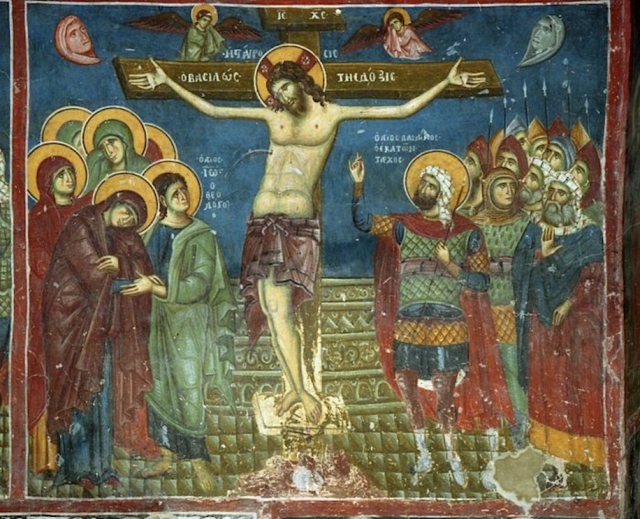


Symbolism and Interpretations
- Cosmic/universal witness: The entire creation reacts—Christ’s death is not just a local event but affects heaven and earth (echoing patristic ideas and prophecies like Amos 8:9).
- Mourning and divine anger: Personifications often show sorrow or aversion.
- Typology: In some readings (influenced by St. Augustine), they represent Old and New Testaments or Church vs. Synagogue.
- Sovereignty and triumph: They affirm Christ’s eternal reign over creation, adapting pagan solar imagery (e.g., Sol Invictus) into a Christian framework.
Later Evolution (14th Century Onward)
The motif peaks in the High Middle Ages but evolves with artistic styles. By the late Gothic and early Renaissance, artists sometimes shift to realistic dark or stormy skies, solar eclipses, or starry nights (e.g., Jan van Eyck’s Crucifixion, c. 1420s, with a waning moon). Personified Sol/Luna become rarer in naturalistic Western painting but persist strongly in traditional Byzantine/Orthodox icons to this day (sun on the left with rays, moon on the right). By the 16th–17th centuries, they largely fade in the West except in conservative or symbolic works (e.g., Raphael’s Mond Crucifixion, c. 1502–1503, with gold/silver orbs).
Note: In some 14th-century frescoes (e.g., Visoki Dečani Monastery, Serbia), the stylized sun and moon have occasionally been misidentified online as “UFOs,” but art historians universally recognize them as traditional symbolic personifications of the celestial bodies witnessing the Crucifixion.
In short, what began as a literal illustration of Gospel darkness grew into one of the richest symbols of Christ’s universal redemptive power—visible from 6th-century manuscripts to modern icons. The sun and moon remind viewers that the Crucifixion was a cosmic turning point witnessed by all creation.
Wednesday, March 25, 2026

Tuesday, March 17, 2026
Celtic Magic

There is no first-hand evidence, she writes, of people being burned in a wicker man — a large figure made of woven branches. Julius Caesar, whose writings provide the earliest surviving report of this, may even be drawing from a much earlier Greek philosopher whose own writings have since been lost.
The practices we do have evidence for tend to be cultural hybrids — especially in early Christian Ireland, where, Ehrmantraut shows, people might have combined a protection spell with a prayer to St Patrick for good measure. As for the remedy for worms: “The medical practitioner is to sing the following charm nine times in the afflicted person’s ear, followed by the Paternoster: ‘gonomil orgomil marbumil’. These words are slightly garbled Old Irish for ‘I wound the beast.’”
Subscribe to:
Posts (Atom)
-
‘May Morning on Magdalen Tower’ 1890, by Holman Hunt Hunt attended the May Morning ceremony and made initial observations about it in 1888....
-
DC Comics Releases Comic Where Jesus Christ Is the Central Point of History.✝️ After 37 years locked in the vault, DC finally released the “...
-
Daniel Maclise, Snap-Apple Night (1833) - as Hallowe'en is known in Kerry As we know it, that is? In all probability, yes, it is , and ...