Biblical Foundation
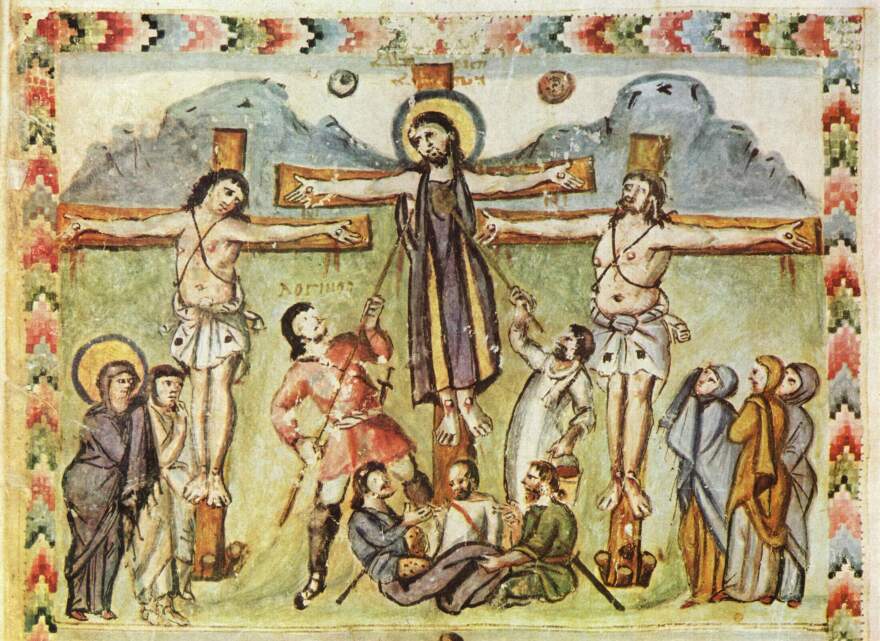
The Gospels describe “darkness over the whole land” from the sixth to the ninth hour (noon to 3 p.m.) while Jesus hung on the cross (Matthew 27:45; Mark 15:33; Luke 23:44–45). Luke specifically notes that “the sun was darkened” (or “the sun’s light failed” / “τοῦ ἡλίου ἐκλιπόντος”). This supernatural daytime darkness—sometimes linked to apocalyptic imagery like Revelation 6:12 (sun turning black, moon blood-red)—gave artists a powerful visual hook. The presence of both sun and moon together (unnatural in reality) underscores the miracle and the universe’s response to Christ’s death.
Earliest Depictions (6th Century)
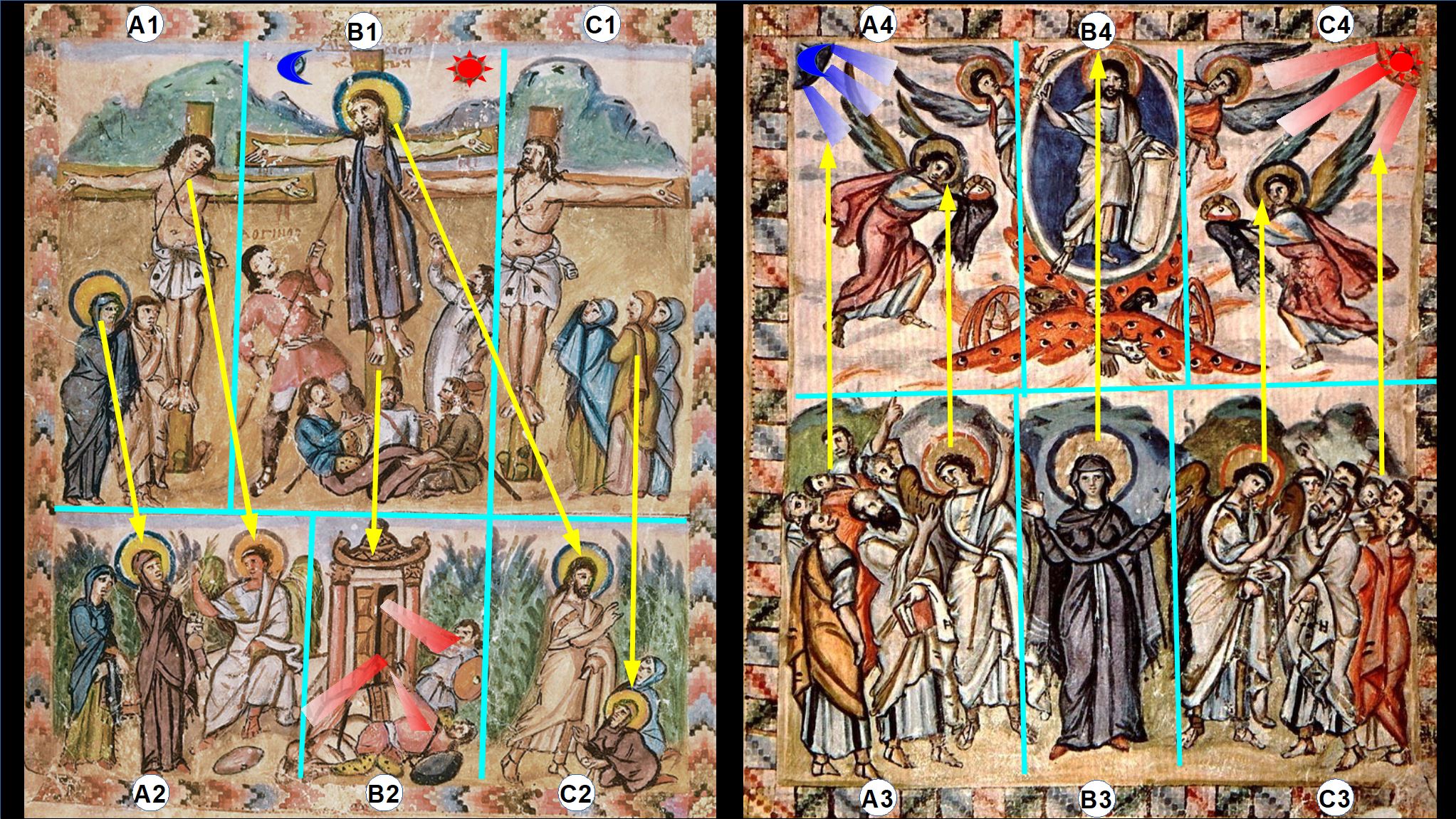
Crucifixion imagery itself was rare before the 5th–6th centuries (early Christians often avoided graphic suffering scenes). One of the oldest surviving examples with the celestial bodies is the Rabbula Gospels (Syriac manuscript, completed 586 CE, now in Florence). Here, a partly eclipsed sun and a personified moon (with a face) hover above the cross against a light sky, with shading hinting at darkness. This sets the pattern: the sun and moon signal both the literal darkness and the cosmic scale of the event.
Medieval Standardization and Personification (8th–13th Centuries)
By the Carolingian period (8th–9th centuries) and onward through Romanesque and Gothic art, sun and moon became standard features in both Eastern (Byzantine/Orthodox) and Western traditions. They are typically shown as:
- Personified busts or figures: Labeled SOL (sun, often male with rays or in a chariot) on one side and LUNA (moon, veiled or crescent-shaped female) on the other. They frequently turn away, weep into their hands, or look sorrowful—symbolizing the universe mourning or God’s cosmic anger at the death of His Son.
- Position: Flanking the top of the cross, sometimes perched on the cross-arms themselves.
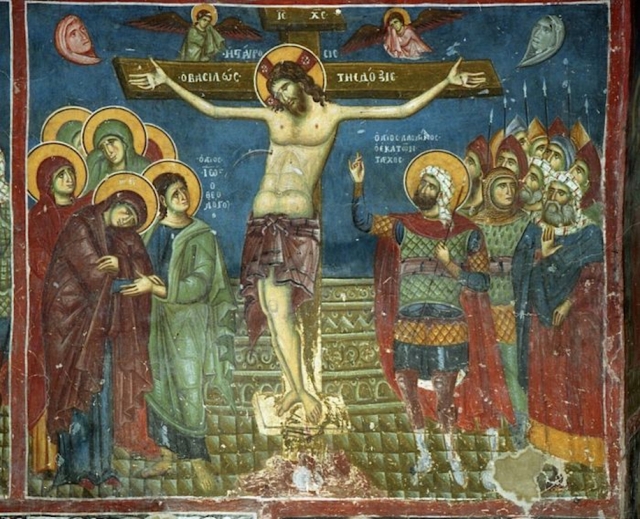
This draws from classical Roman iconography (Sol and Luna as powerful deities in imperial art and chariot motifs) but repurposes it for Christian meaning. In Byzantine icons and frescoes, they remain stylized disks with faces or rays (sun often darkened, moon sometimes red). In Western manuscripts, ivories, and enamels, they appear in elaborate scenes alongside angels, Mary, John, and sometimes Ecclesia/Synagoga (Church and Synagogue) or Earth/Sea personifications.
Examples include:
- Ottonian Sacramentary of Henry II (early 11th century): Weeping Sol (rayed) and veiled Luna turn away in grief.
- 12th-century Limoges enamel plaques and Romanesque crucifixes: Sun and moon as medallions or figures emphasizing Christ’s “cosmic sovereignty.”


Symbolism and Interpretations
- Cosmic/universal witness: The entire creation reacts—Christ’s death is not just a local event but affects heaven and earth (echoing patristic ideas and prophecies like Amos 8:9).
- Mourning and divine anger: Personifications often show sorrow or aversion.
- Typology: In some readings (influenced by St. Augustine), they represent Old and New Testaments or Church vs. Synagogue.
- Sovereignty and triumph: They affirm Christ’s eternal reign over creation, adapting pagan solar imagery (e.g., Sol Invictus) into a Christian framework.
Later Evolution (14th Century Onward)
The motif peaks in the High Middle Ages but evolves with artistic styles. By the late Gothic and early Renaissance, artists sometimes shift to realistic dark or stormy skies, solar eclipses, or starry nights (e.g., Jan van Eyck’s Crucifixion, c. 1420s, with a waning moon). Personified Sol/Luna become rarer in naturalistic Western painting but persist strongly in traditional Byzantine/Orthodox icons to this day (sun on the left with rays, moon on the right). By the 16th–17th centuries, they largely fade in the West except in conservative or symbolic works (e.g., Raphael’s Mond Crucifixion, c. 1502–1503, with gold/silver orbs).
Note: In some 14th-century frescoes (e.g., Visoki Dečani Monastery, Serbia), the stylized sun and moon have occasionally been misidentified online as “UFOs,” but art historians universally recognize them as traditional symbolic personifications of the celestial bodies witnessing the Crucifixion.
In short, what began as a literal illustration of Gospel darkness grew into one of the richest symbols of Christ’s universal redemptive power—visible from 6th-century manuscripts to modern icons. The sun and moon remind viewers that the Crucifixion was a cosmic turning point witnessed by all creation.


